
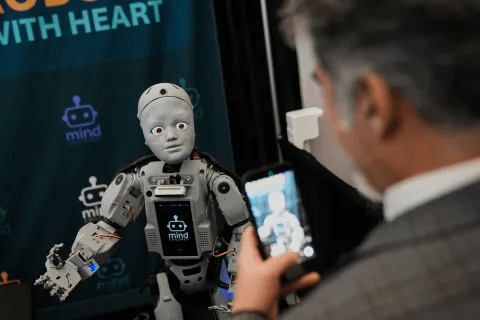
Humanoid robots China lead: Silicon Valley summit exposes global power shift
China’s humanoid robot dominance accelerates as over 50 companies cross $100M funding mark
Introduction
The phrase humanoid robots China lead is no longer speculative.
It is measurable, funded, and visible.
At the Humanoids Summit in Mountain View, more than 2,000 engineers, founders, and researchers gathered to assess the commercial future of humanoid robotics. According to McKinsey & Company researchers cited at the event, around 50 companies globally have raised at least $100 million to build humanoid robots. China alone accounts for about 20 of them, surpassing North America’s 15.
This concentration of capital, hardware production, and government policy now places China in the clear lead of the humanoid robotics race.
Why the humanoid robots China lead is accelerating
The current humanoid robots China lead is driven by coordinated industrial policy and direct government support.
China introduced a national mandate last year requiring the creation of a complete “humanoid ecosystem by 2025.”
Government incentives cover component manufacturing and robot deployment.
As a result, Chinese firms dominated the expo floor at the Humanoids Summit.
The most common robots on display came from China’s Unitree, largely because U.S. researchers purchase its lower-cost humanoid models for testing new software.
This pricing advantage increases adoption and accelerates iteration cycles.
Faster cycles compound China’s lead.
Silicon Valley’s renewed bet on physical AI
For years, robotics failed to excite investors.
They saw the sector as complex, capital-heavy, and slow.
That changed with generative AI.
According to summit organizer Modar Alaoui, the commercial boom in AI reignited long-standing ambitions to build humanoid robots that can physically operate like humans. Researchers now believe that physical embodiments of AI will become the norm. The only question, Alaoui said, is how long it will take.
The shift is already visible in investment patterns and startup formation.
One example is Haptica Robotics, founded only a week before the summit.
Its co-founder, Stanford researcher Cosima du Pasquier, stated that the conference attendees themselves became the company’s first customers.
Technical barriers remain high
Despite rising capital and interest, the technical challenge remains enormous.
Du Pasquier described humanoid development as “a very, very big hill to climb.”
Robotics pioneer Rodney Brooks echoed that skepticism in a September essay, arguing that even billions in funding may not produce true dexterity in current humanoids.
Meanwhile, industrial robots already outperform both humans and humanoids at speed and precision for single-task manufacturing roles.
This gap explains why general-purpose humanoids remain further from commercial reality than entertainment or logistics robots.
Commercial pilots signal gradual progress
Practical deployments have begun.
Agility Robotics announced that its humanoid-style robot Digit is entering a Mercado Libre distribution facility in Texas.
Disney will deploy a walking robotic Olaf in its Hong Kong and Paris theme parks in early 2026.
These deployments remain specialized.
However, they demonstrate steady progress toward functional autonomy.
The robotics industry now mirrors the early years of self-driving cars.
In 2014, Google displayed its bubble-shaped autonomous prototype.
Eleven years later, Waymo robotaxis operate daily in the same city.
The same timeline logic now frames humanoid development.
U.S. response to the humanoid robots China lead
The Association for Advancing Automation, founded in 1974, is lobbying the U.S. government to adopt a national robotics strategy.
According to its president Jeff Burnstein, the U.S. retains deep AI expertise and advanced technology.
Yet he acknowledged that China currently holds stronger momentum in humanoids.
This momentum now influences supply chains, research agendas, and workforce strategy worldwide.
For companies navigating this shift, aligning data infrastructure, automation planning, and customer operations becomes essential.
To support these transitions, many global firms are adopting advanced relationship management platforms such as Pipedrive CRM [2X the usual trial with no CC and no commitments], while also working with strategic partners like Uttkrist.
Explore the services of Uttkrist, our services are global in nature and highly enabling for businesses of all types, drop us an inquiry in your suitable category:
https://uttkrist.com/explore
Conclusion
The humanoid robots China lead now reflects measurable industrial momentum, coordinated policy, and sustained capital flows.
Silicon Valley remains innovative.
However, China currently sets the pace.
As this competition reshapes automation, supply chains, and labor markets, a central question remains:
Will the next decade’s defining industrial platform be built in Silicon Valley—or in China?
Explore Business Solutions from Uttkrist and our Partners’, https://uttkrist.com/explore