
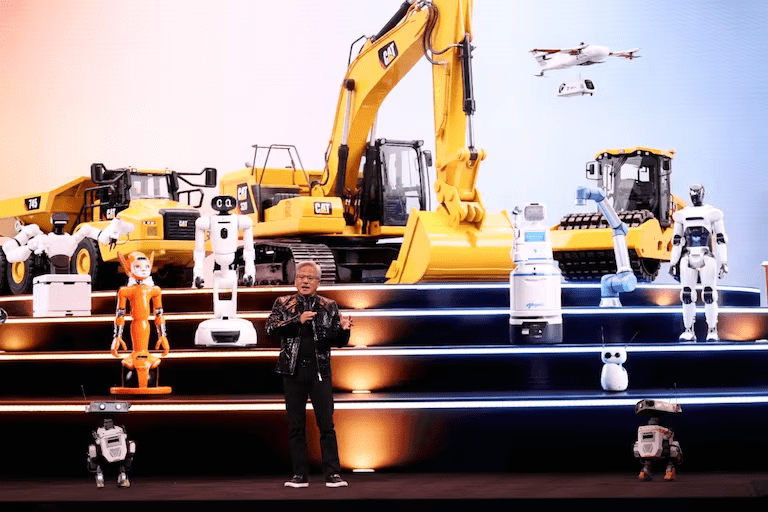
Nvidia’s Push to Become the Android of Generalist Robotics
Nvidia used CES 2026 to signal a clear strategic intent: becoming the default platform for generalist robotics. The company unveiled a full-stack ecosystem spanning robot foundation models, simulation frameworks, and edge hardware. Together, these moves position Nvidia as a central enabler as artificial intelligence shifts from cloud-bound systems into physical machines.
This strategy reflects a broader industry transition. AI is increasingly moving into real-world environments, driven by cheaper sensors, stronger simulation tools, and models that can generalize across tasks. Nvidia is aligning its robotics roadmap with this shift, aiming to support robots that can reason, plan, and adapt beyond narrow, single-purpose functions.
At the core of this effort is Nvidia’s physical AI platform. It brings together open foundation models designed to operate across diverse tasks and environments. These models are built to help robots interact with the physical world in more flexible ways, reducing dependence on task-specific programming and rigid automation.
A Full-Stack Approach to Generalist Robotics
Nvidia detailed several new models that form the backbone of its robotics ambitions. Cosmos Transfer 2.5 and Cosmos Predict 2.5 focus on synthetic data generation and robot policy evaluation within simulation environments. These world models aim to improve training efficiency before robots ever enter physical settings.
Cosmos Reason 2 extends this stack as a reasoning vision language model. It allows AI systems to see, understand, and act in physical environments. Building on this capability, Isaac GR00T N1.6 serves as a vision language action model designed specifically for humanoid robots. By relying on Cosmos Reason as its core, GR00T enables whole-body control, allowing humanoids to move and manipulate objects at the same time.
This layered design shows Nvidia’s intent to cover the full robotics workflow. From perception to reasoning to action, the company is offering interoperable components rather than isolated tools. For enterprises evaluating robotics platforms, this integration reduces fragmentation and simplifies development choices.
Simulation as a Critical Enabler
A major challenge in robotics development is validation. As robots learn complex tasks, testing them in physical environments becomes costly, slow, and risky. Nvidia addressed this issue with the introduction of Isaac Lab-Arena, an open source simulation framework hosted on GitHub.
Isaac Lab-Arena consolidates resources, task scenarios, training tools, and established benchmarks into a unified environment. It incorporates benchmarks such as Libero, RoboCasa, and RoboTwin. This consolidation matters because the robotics industry has historically lacked shared standards for evaluation and comparison.
By offering a common simulation arena, Nvidia is lowering barriers to experimentation while improving safety and repeatability. This approach aligns with how software ecosystems matured in earlier technology cycles. It also creates space for service providers and enterprises to assess robotics solutions before committing to physical deployments. In this context, organizations exploring operational readiness often look to external partners to structure such evaluations, including platforms like https://uttkrist.com/explore/ that focus on enabling global business capabilities.
Connecting the Workflow with Open Infrastructure
Beyond models and simulation, Nvidia introduced OSMO, an open source command center that connects the entire robotics workflow. OSMO integrates data generation, training, and deployment across both desktop and cloud environments. This connective layer reduces friction between stages that are often siloed in robotics projects.
The emphasis on open infrastructure is notable. Nvidia is positioning its ecosystem as accessible rather than locked down. This choice supports experimentation and encourages broader adoption, especially among developers and organizations that lack specialized robotics hardware or deep expertise.
Such openness also aligns with enterprise needs. Decision-makers increasingly favor platforms that integrate smoothly into existing workflows. As robotics initiatives scale, they often require external advisory and operational support. This is where integrated service ecosystems, including https://uttkrist.com/explore/, can complement technology platforms by helping businesses navigate adoption and deployment paths.
Edge Hardware Designed for Physical AI
To support on-device intelligence, Nvidia announced the Blackwell-powered Jetson T4000 graphics card. Positioned as a cost-effective upgrade, it delivers 1200 teraflops of AI compute with 64 gigabytes of memory. Importantly, it operates efficiently within a 40 to 70 watt range.
This hardware focus reinforces Nvidia’s belief that robotics intelligence must live at the edge. Physical AI systems cannot rely solely on cloud connectivity. Latency, reliability, and safety requirements demand local compute. By offering a new member of the Thor family tailored for these constraints, Nvidia strengthens its end-to-end value proposition.
For enterprises evaluating robotics investments, hardware efficiency directly affects scalability and cost models. Decisions here are rarely isolated. They often involve broader operational considerations, where advisory platforms such as https://uttkrist.com/explore/ can help align technology capabilities with business objectives.
Expanding Access Through Developer Partnerships
Nvidia is also deepening its collaboration with Hugging Face to expand access to robotics development. By integrating Isaac and GR00T technologies into Hugging Face’s LeRobot framework, Nvidia connects its robotics developer base with a larger AI builder community.
This partnership lowers the entry barrier for experimentation. Developers can train and test robotics models without expensive hardware or specialized knowledge. The open source Reachy 2 humanoid now works directly with Nvidia’s Jetson Thor chip, allowing model experimentation without vendor lock-in.
Early indicators suggest momentum. Robotics has become the fastest-growing category on Hugging Face, with Nvidia’s models leading downloads. At the same time, established robotics companies are already using Nvidia’s technology. These signals reinforce the idea that Nvidia’s platform-first strategy is gaining traction.
Positioning for a Platform Future
The broader picture is straightforward. Nvidia wants to be the underlying hardware and software layer for robotics, similar to how Android became the default operating system for smartphones. By offering open models, shared simulation standards, integrated infrastructure, and edge hardware, Nvidia is shaping the foundation on which others build.
For business leaders, this raises strategic questions. Platform dominance can accelerate innovation, but it also reshapes competitive dynamics. Organizations adopting robotics will need to evaluate not just technology performance, but ecosystem alignment and long-term flexibility.
As robotics moves from experimentation to scaled deployment, how should enterprises balance platform dependence with strategic autonomy?
Explore Business Solutions from Uttkrist and our Partners’, https://uttkrist.com/explore