
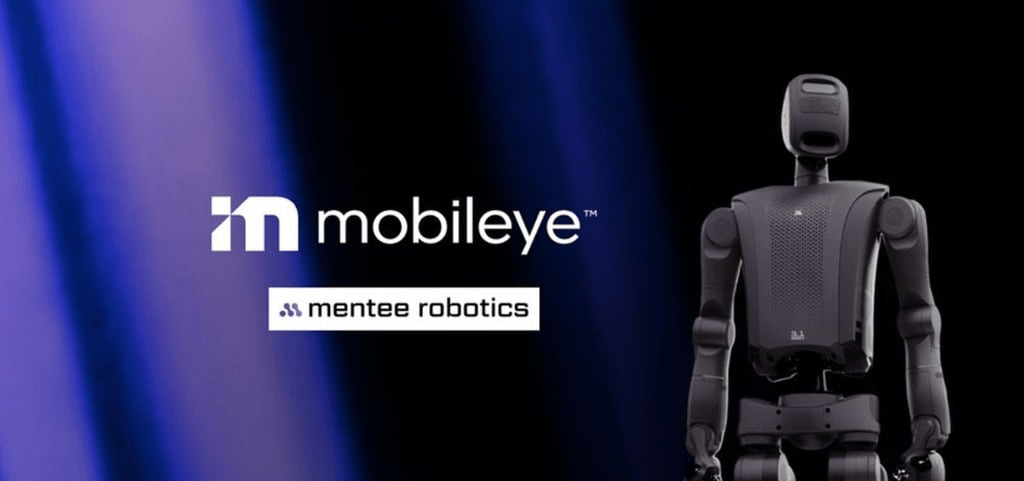
Mobileye acquires Mentee Robotics for $900M to expand humanoid robotics
Mobileye acquires Mentee Robotics in a $900 million deal announced during CES in Las Vegas. The acquisition marks what the company calls Mobileye 3.0. It extends the business beyond automotive safety and autonomous driving into humanoid robotics and physical artificial intelligence.
Mobileye built its reputation supplying computer vision chips for automotive safety and advanced driver assistance systems. Over time, it expanded into autonomous driving software and chips. This acquisition signals a strategic move to apply those capabilities to robots that interact with humans and the physical world.
The deal structure combines cash and stock. Mobileye will pay about $612 million in cash and issue up to 26.2 million shares of common stock. The transaction received approval from the Mobileye board and Intel, its largest shareholder. It is expected to close in the first quarter and will modestly increase operating expenses in 2026.
This move reframes Mobileye’s long-term trajectory. It positions robotics as a core pillar alongside automotive autonomy, rather than an adjacent experiment.
From automotive autonomy to physical AI systems
Mobileye describes the acquisition as a decisive step toward physical artificial intelligence. These systems are designed to understand context and intent. They also act naturally with humans and in real environments.
Mentee Robotics develops humanoid robots. Following the transaction, it will continue operating as an independent unit within Mobileye. This structure allows focused development while leveraging Mobileye’s scale and infrastructure.
The strategic logic centers on reuse of core capabilities. Mobileye’s expertise in perception, decision-making, and productizing advanced AI now extends beyond vehicles. According to the company, the same foundations that allow cars to navigate complex environments can be applied to humanoid robots.
For business leaders, this reflects a broader pattern. Companies with mature AI platforms are seeking new physical domains to deploy them. Robotics offers that next frontier.
As organizations assess similar expansion paths, it is worth exploring advisory services that support complex technology transitions. Explore the services of Uttkrist. Our services are global in nature and highly enabling for businesses of all types. Drop an inquiry in your suitable category: https://uttkrist.com/explore/
Financial scale and operational implications
The acquisition occurs against a backdrop of strong automotive momentum. Mobileye stated its current automotive revenue pipeline stands at $24.5 billion over the next eight years. That figure is driven by advanced vehicle autonomy and core driver assistance technologies. It represents an increase of more than 40% compared to January 2023.
This financial base gives Mobileye room to invest. Humanoid robotics development is capital intensive. It requires compute, training infrastructure, and long product cycles. Mentee stands to benefit from access to Mobileye’s advanced AI training resources.
The company also announced recent commercial traction. A top 10 automaker agreed to purchase 9 million EyeQ6H-based Surround ADAS systems. Mobileye now estimates future delivery of more than 19 million of these systems.
These data points explain how Mobileye can absorb the cost of expansion. Robotics becomes a calculated extension rather than a speculative bet.
For enterprises navigating similar investment decisions, structured insight and scenario evaluation matter. Leaders can explore frameworks and services that support these assessments at https://uttkrist.com/explore/.
What Mobileye 3.0 signals for robotics and AI
Mobileye’s leadership frames the acquisition as the beginning of a new chapter. By combining humanoid robotics breakthroughs with automotive AI expertise, the company aims to lead the evolution of physical AI across robots and autonomous vehicles.
This signals a convergence trend. Boundaries between automotive autonomy and robotics are blurring. Perception, planning, and human interaction are becoming shared competencies.
For CXOs and investors, the implication is clear. Competitive advantage will increasingly come from platforms that can move across physical domains. The question is not whether AI leaves the screen, but who controls the systems that operate in the real world.
How should organizations evaluate when and where to extend their AI capabilities into physical systems?
Explore Business Solutions from Uttkrist and our Partners’, https://uttkrist.com/explore
https://qlango.com/