
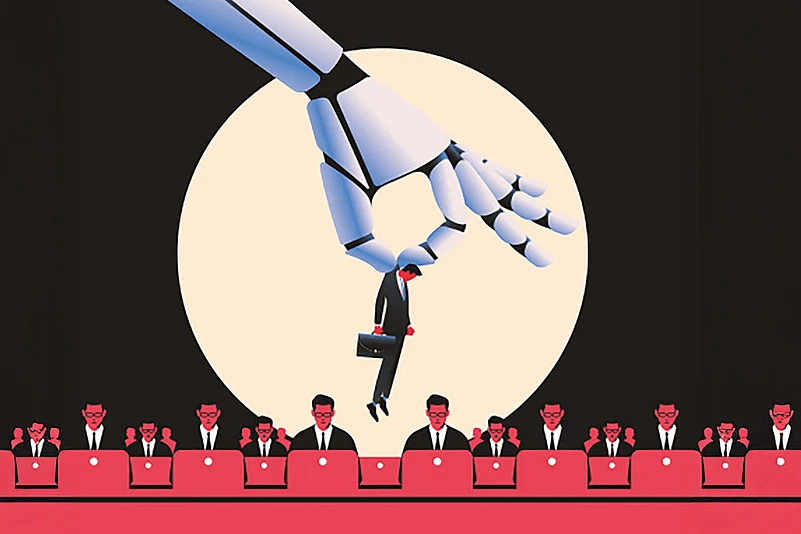
Investors Predict AI Is Coming for Labor in 2026
Concerns about how artificial intelligence will affect workers continue to rise alongside rapid enterprise adoption. As a result, investors now predict that AI impact on labor in 2026 will become unavoidable. Evidence already suggests disruption is underway. A November MIT study estimated that 11.7% of jobs could already be automated using AI. Meanwhile, surveys show employers are eliminating entry-level roles because of the technology. In parallel, companies increasingly cite AI as a driver behind layoffs.
Therefore, as enterprises deepen AI adoption, many leaders are reassessing how many employees they truly need. This reassessment sets the stage for a pivotal shift in workforce strategy.
Enterprise Investors See Workforce Disruption Accelerating
In a recent survey of enterprise-focused venture capitalists, several investors said AI will significantly reshape the enterprise workforce in 2026. Notably, the survey did not explicitly ask about labor impacts. Even so, the topic surfaced repeatedly, signaling its urgency.
Eric Bahn, co-founder and general partner at Hustle Fund, expects clear effects on labor in 2026, although outcomes remain uncertain. He noted that repetitive roles may be automated first. However, he also raised the possibility that more complex, logic-driven roles could follow.
“I want to see what roles that have been known for more repetition get automated, or even more complicated roles with more logic become more automated,” Bahn said. “Is it going to lead to more layoffs? Is there going to be higher productivity? Or will AI just be an augmentation for the existing labor market to be even more productive in the future?”
Thus, while the direction is clear, the magnitude of AI impact on labor in 2026 remains unresolved.
Budgets Shift From Human Labor to AI Investment
At the same time, investors expect budget reallocations to accelerate this shift. Marell Evans, founder and managing partner at Exceptional Capital, predicted that companies increasing AI spending will pull funds from labor and hiring budgets.
“I think on the flip side of seeing an incremental increase in AI budgets, we’ll see more human labor get cut and layoffs will continue to aggressively impact the U.S. employment rate,” Evans said.
Similarly, Rajeev Dham, managing director at Sapphire, agreed that 2026 budgets will increasingly favor AI over labor. Adding to this view, Jason Mendel of Battery Ventures said AI will move beyond productivity tools.
“2026 will be the year of agents as software expands from making humans more productive to automating work itself,” Mendel said, describing a direct human-labor displacement in some areas.
Consequently, AI impact on labor in 2026 may become embedded directly into enterprise operating models.
AI as Automation Driver or Executive Scapegoat
However, not all workforce reductions may stem directly from AI capability. Antonia Dean, partner at Black Operator Ventures, warned that AI could also become a convenient explanation for cost-cutting decisions.
She observed that many enterprises, regardless of AI readiness, may cite increased AI investment to justify trimming workforces. In her view, AI may serve as a scapegoat for executives covering past strategic missteps rather than a true operational necessity.
This dynamic complicates how employees and markets interpret layoffs tied to AI narratives.
Worker Anxiety Persists Despite Reframing Efforts
Many AI companies argue that their technology does not eliminate jobs. Instead, they claim it shifts workers toward higher-skilled roles by automating repetitive tasks. Yet skepticism remains high.
According to investors active in this space, fears about job automation are unlikely to fade in 2026. As automation moves from assistance to execution, worker anxiety continues to track enterprise adoption closely.
For organizations navigating this transition, advisory and operational support will matter. In this context, leaders increasingly explore partners that help align technology strategy with workforce realities. Explore the services of Uttkrist. Our services are global in nature and highly enabling for businesses of all types. Drop an inquiry in your suitable category at https://uttkrist.com/explore/
As enterprises balance productivity, automation, and accountability, how transparently will leaders address the real drivers behind workforce change?
Explore Business Solutions from Uttkrist and our Partners’, https://uttkrist.com/explore