Sauron Home Security Startup CEO Signals a Reset on Product and Timeline
A new CEO, a delayed launch, and a rethink of premium home security
The Sauron home security startup CEO has set a clear direction early in his tenure. The company is slowing execution to refine its product foundation.
After raising $18 million and targeting a 2025 launch, Sauron now expects its first customer deployments in late 2026 at the earliest. This shift reflects unresolved decisions around sensors, deterrence design, and system integration.
Rather than rushing to market, leadership is prioritizing durability, reliability, and service quality.
Why Sauron entered the security market
Sauron was founded after repeated failures of existing home security systems. One founder experienced an attempted intrusion that went undetected. Another faced similar shortcomings at a different property.
These experiences led to the launch of Sauron in 2024. The ambition was direct: design a system positioned as military-grade for ultra-wealthy households.
The concept resonated within Bay Area circles. Crime anxiety remained a frequent concern, even as official data showed declines.
Capital raised, expectations set
The startup raised $18 million from executives associated with Flock Safety and Palantir, along with defense-focused investors. It exited stealth promising a first-quarter 2025 launch.
That timeline has now been formally reset. According to the Sauron home security startup CEO, the company is still in a development-heavy phase. Product assumptions are being tested rather than locked.
This recalibration underscores how complex high-end security hardware remains.
A Sonos veteran takes charge
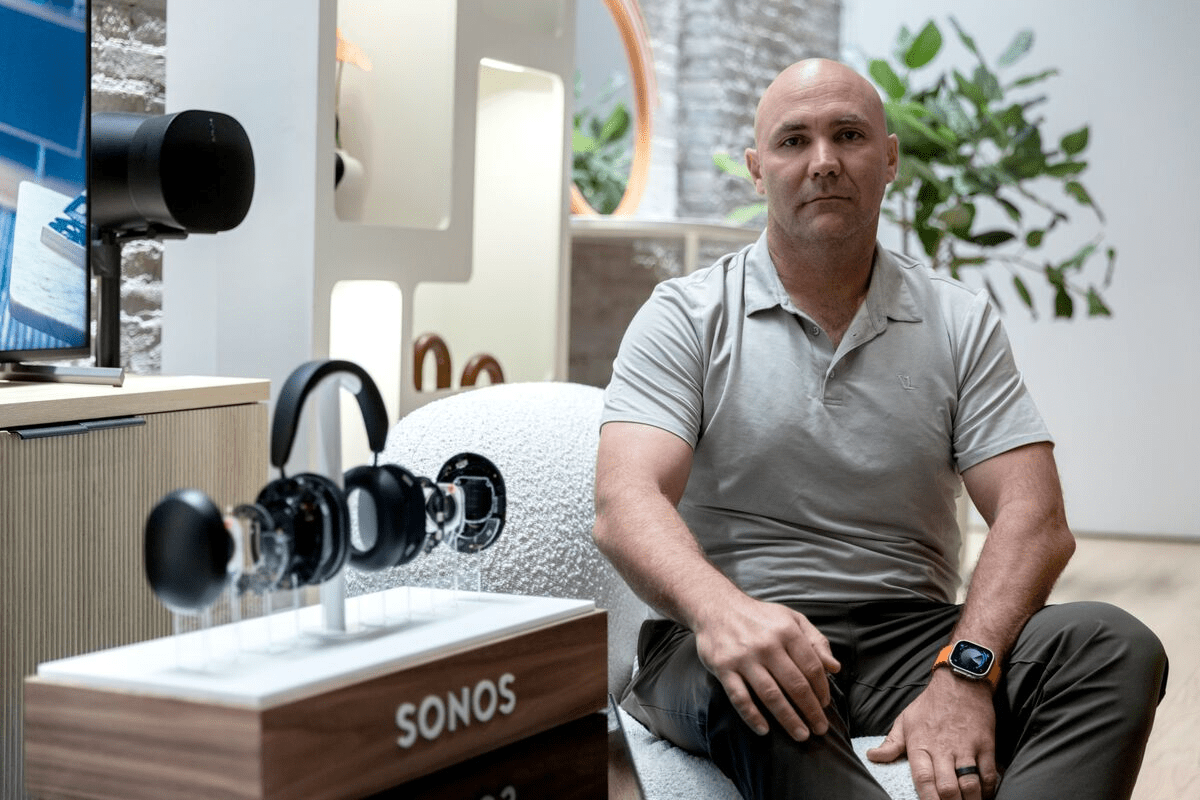
Maxime “Max” Bouvat-Merlin joined Sauron after nearly nine years at Sonos, including time as chief product officer. He assumed the CEO role just last month.
His early focus has been foundational. He is evaluating which sensors to deploy, how deterrence should function, and how quickly products can realistically reach homes.
As a result, Sauron is now planning a phased rollout rather than a single full launch.
What the product looks like today
Sauron’s system centers on camera pods with multiple sensors. These may include LiDAR, radar, and thermal imaging. The pods connect to servers running machine learning software for computer vision.
A defining element is the 24/7 concierge service. It is staffed by former military and law enforcement professionals. Their role extends beyond monitoring. They also help refine detection models and reduce false positives.
False alarms remain a major weakness across the security industry.
Deterrence before intrusion
The company is designing deterrence to activate earlier than traditional systems. Instead of reacting after entry, Sauron wants to detect suspicious behavior beforehand.
This may include identifying repeated drive-bys or signs of surveillance. Potential deterrents include sound, lighting, and other signaling methods.
The Sauron home security startup CEO has emphasized that the goal is prevention, not escalation.
Early mentions of drones now sit on the roadmap rather than in near-term plans.
Starting premium, scaling cautiously
Sauron plans to begin with customers where safety is a primary concern. These users expect high-touch service and reliability.
Initial growth will rely on word of mouth. Expansion into what leadership calls “mass premium” will come later.
The company has fewer than 40 employees today. It expects to add only 10 to 12 more in 2026. A Series A raise is planned for mid-2026, tied to demonstrated progress rather than urgency.
Privacy and surveillance trade-offs
Facial recognition and license plate detection raise predictable privacy concerns. Leadership is considering a trust-based access model. Homeowners would explicitly approve known individuals. Others remain untrusted by default.
License plate data may help identify suspicious patterns, such as repeated neighborhood passes. Former law enforcement staff will help interpret these signals.
Sauron positions itself as a technology-first entrant rather than a legacy security firm adding software later.
An execution-first mindset
Significant questions remain. Manufacturing locations are not finalized. Sensor configurations continue to evolve. Deployment models must adapt to both estates and dense urban homes.
For now, the Sauron home security startup CEO is focused on internal credibility. His approach favors proof over promises. More product details are expected next year.
Explore the services of Uttkrist, our services are global in nature and highly enabling for businesses of all types, drop us an inquiry in your suitable category: https://uttkrist.com/explore
As premium hardware startups slow down to refine fundamentals, does execution discipline now outweigh speed as the true differentiator?
Explore Business Solutions from Uttkrist and our Partners’, Pipedrive CRM [2X the usual trial with no CC and no commitments] and more uttkrist.com/explore